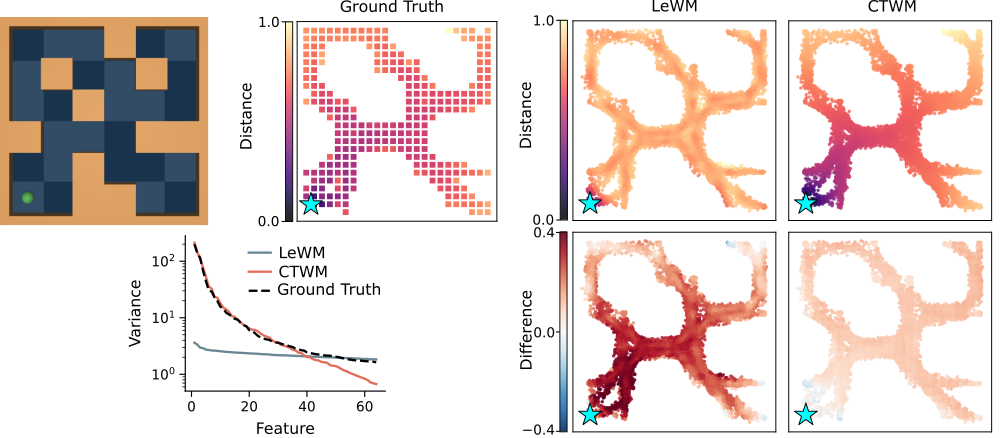
New paper led by Michael Hauri & Peter Buttaroni: “Learning Commute-Time-Preserving World Models for Planning.” We show how to shape a world model’s latent space so its distances mean something for planning.
📄 https://arxiv.org/abs/2610.01373
💻 https://github.com/fmi-basel/commute-time-preserving-world-models
🌐 https://ctwm-website.github.io/
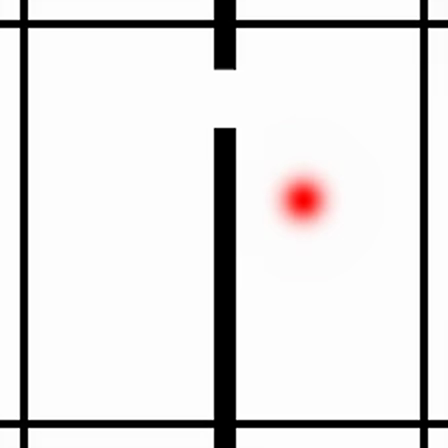
Goal
LeWM
CTWM (ours)
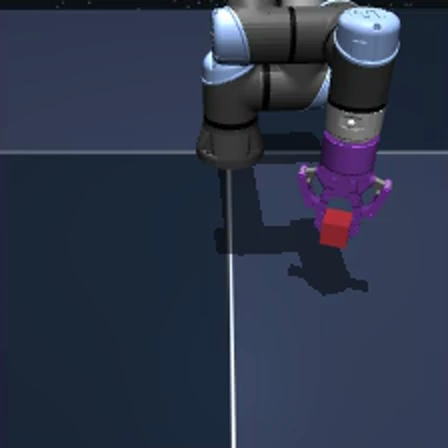
Goal
LeWM
CTWM (ours)
Rats explore a maze with no reward in sight. Weeks later, when food finally appears, they do not mess around – instead they beeline straight to it, using shortcuts they never took before. Tolman called this “latent learning”: animals build a map of their world before they know what it’s for.
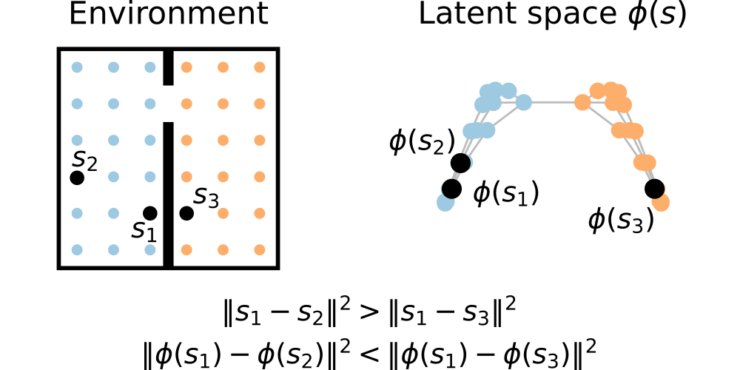
But a map is only useful if you can measure distances on it. When an AI agent builds its own internal “map” (its latent space) purely from experience, what should distance in that map actually mean?
Most latent planners pick actions that reduce goal distance in latent space. But is straight-line the right notion of “close”? Commute-time distance measures how long a random walker takes to reach a goal and back. It captures bottlenecks, dead ends, shortcuts. Can latent distance reflect this?
Graph theory says yes! If the latent space is aligned with the eigenvectors of the environment’s graph Laplacian, and correctly scaled, i.e. choosing the right metric, straight-line distance in that space is commute-time distance.
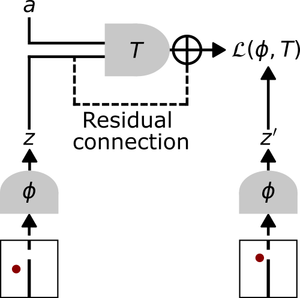
The catch: most self-supervised learning pushes representations to spread out evenly in every direction – which destroys exactly the scaling you need. We combine residual prediction with a log-determinant regularizer instead and prove it recovers the correctly scaled representation.
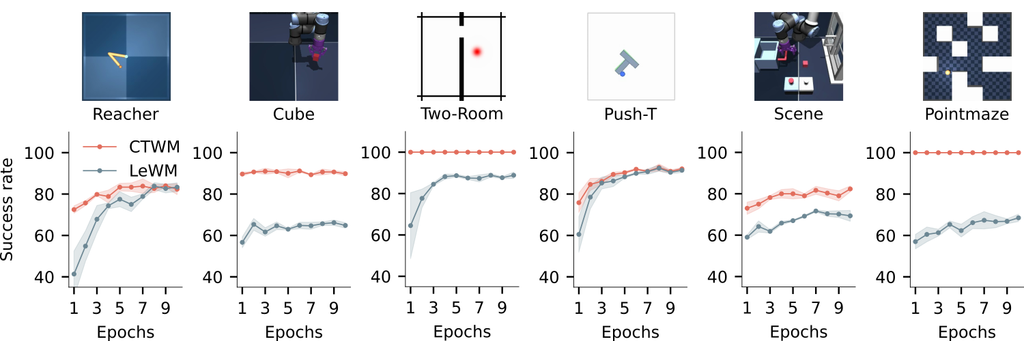
Across six pixel-based goal-reaching tasks (navigation and manipulation) CTWM matches or beats LeWM, a strong task-agnostic baseline, using half the parameters (9M vs. 18M).
You can see why directly: in PointMaze, CTWM’s latent distances track the maze’s true commute-time structure far more closely than LeWM’s, especially around bottlenecks where it matters most for planning.