Like every year, the lab is excited to attend and present at the Bernstein Conference and Satellite workshops.
Workshop talks
Monday 28th, 15:05-15:35 (room 3.104)
Rory will give the talk “Connectome-constrained spiking network models of functional activity” in the Satellite Workshop: “Advances in optimization of biologically constrained models and how to use them”
We present ongoing work in the lab to construct a model of a place cell circuit in larval zebrafish, constrained by dynamical connectomics datasets in which calcium activity and connectomic structure are obtained for the same neurons. Before fitting the real data, we assess identifiability in a teacher-student paradigm, testing generalisation and perturbation responses under realistic data limitations, and show that performance is robust to partial calcium recordings but degrades rapidly under partial connectome reconstruction.
Monday 28th, 14:05-14:35 (room 3.104)
Julia will give the talk “Theory behind surrogate gradients and using them to study connectivity structures in task-optimized networks.” in the Satellite Workshop: “Advances in optimization of biologically constrained models and how to use them”
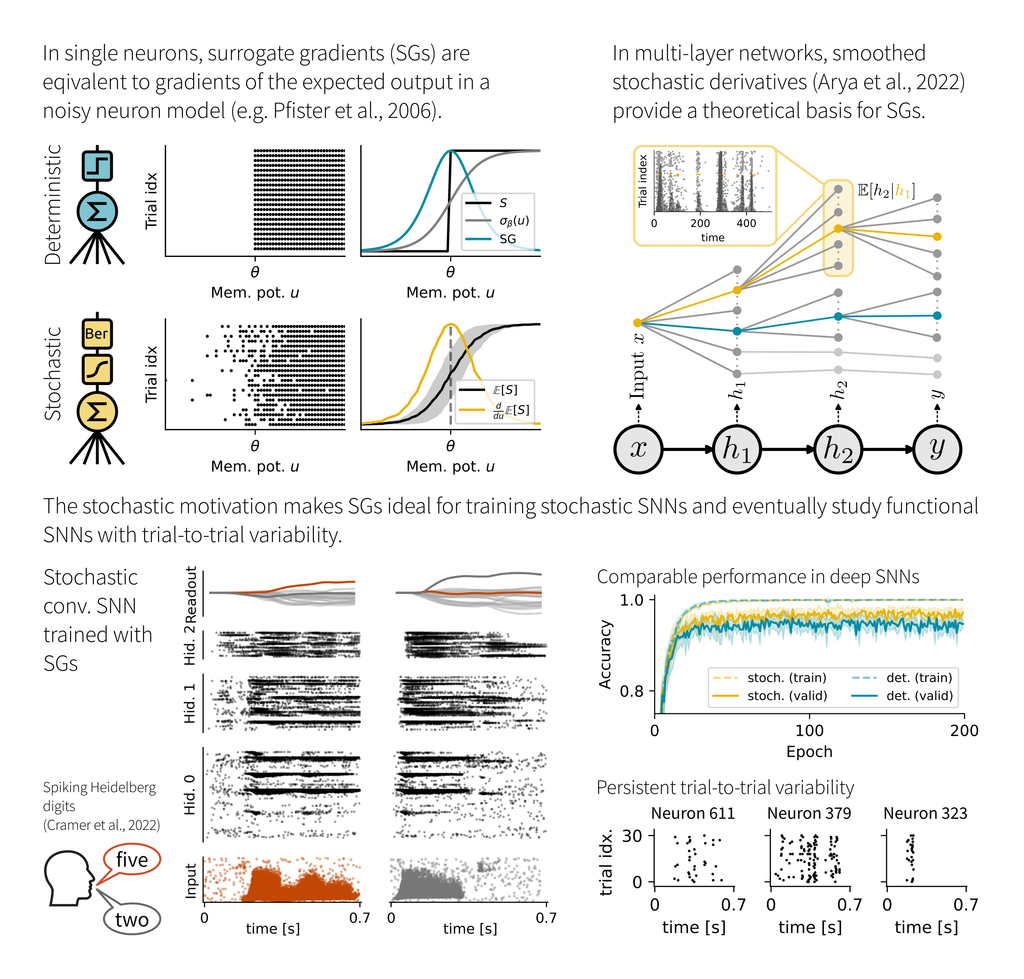
Surrogate gradients (SGs) are an empirically proven method for training spiking neural networks (SNNs). In this workshop, we will cover their theoretical foundations and discuss their implications for training SNNs. Finally, we will provide an outlook on using SG-trained SNNs to uncover shared principles in their learned connectivity structures.
Monday 28th, 16:30-17:00 (room: 1.101)
Friedemann will give the talk “Closing the Loop: From Representation Learning to Local Plasticity and Back” in the workshop “Reconciling biology and function in large-scale brain models”
Posters
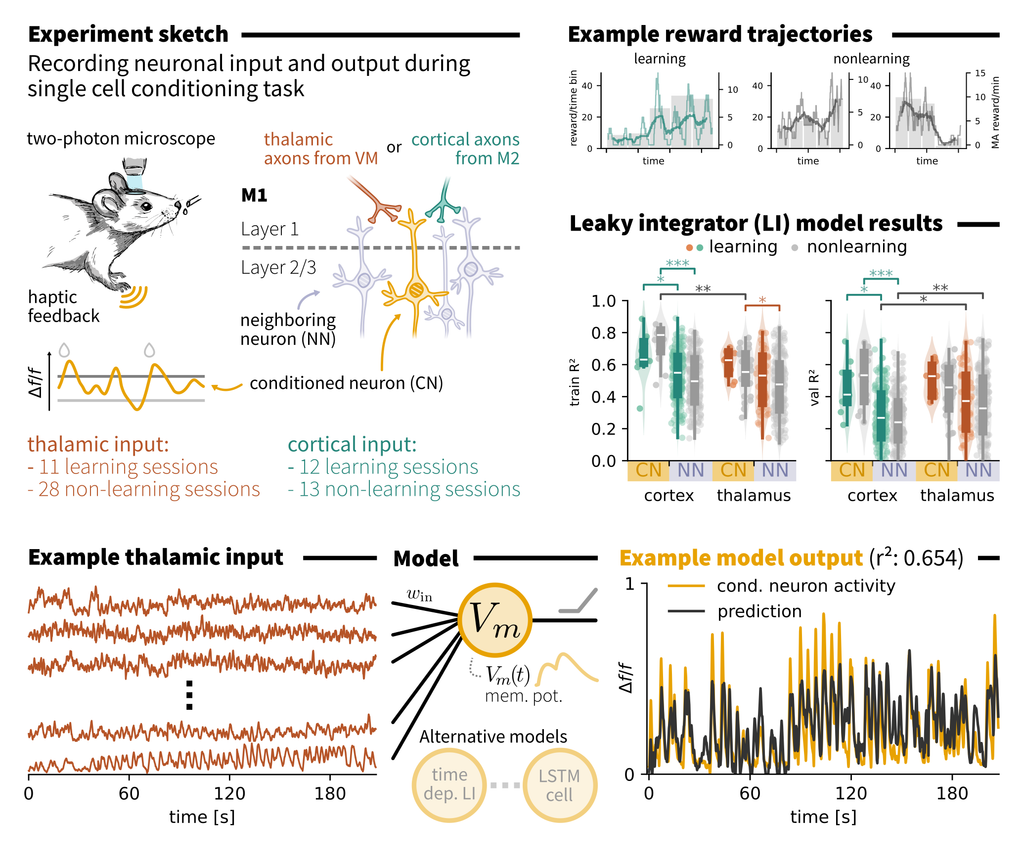
1-009: Dissecting the role of afferent input in a cortical neuron model constrained by real input-output data
Tuesday 29th, 16:30-18:00 (Julia)
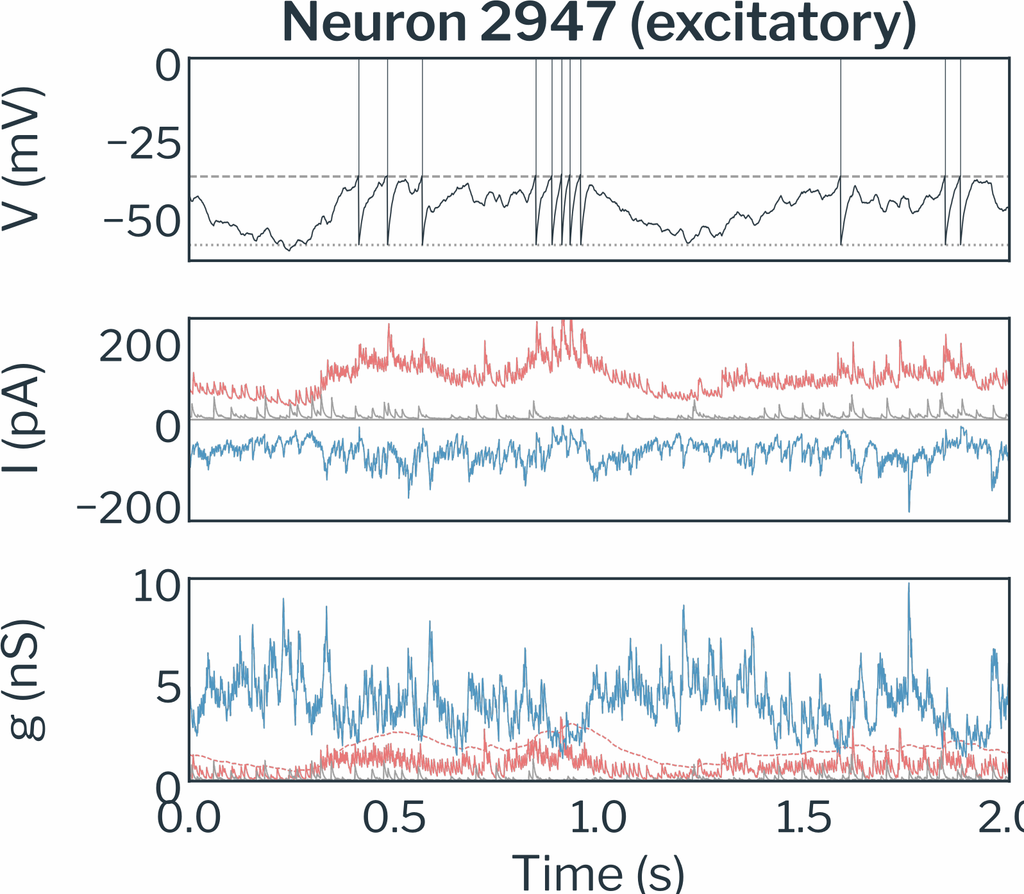
How cortical neurons integrate inputs from different areas and how learning affects this integration remain central questions in circuit neuroscience. We address them by constructing models constrained to simultaneously recorded output and area-specific input data, showing that thalamic inputs provide generally readable, consistent signals, whereas cortical inputs tend to be more neuron-specific.
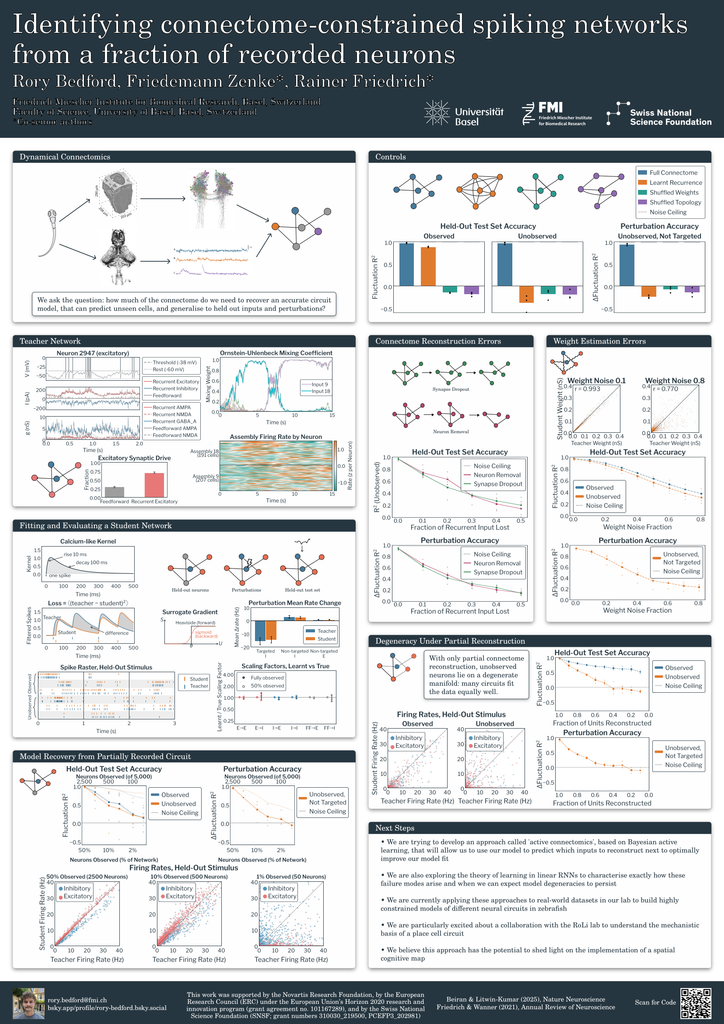
1-028: Identifying connectome-constrained spiking networks from a fraction of recorded neurons
Tuesday 29th, 16:30-18:00 (Rory)
We explore the identifiability of spiking neural network models fit to dynamical connectomics datasets, in which calcium activity and connectomic structure are obtained for the same circuit. In a teacher-student paradigm, we assess fitted models on generalisation and perturbation responses under realistic data limitations, showing that performance is robust to partial calcium recordings but degrades rapidly under partial connectome reconstruction.
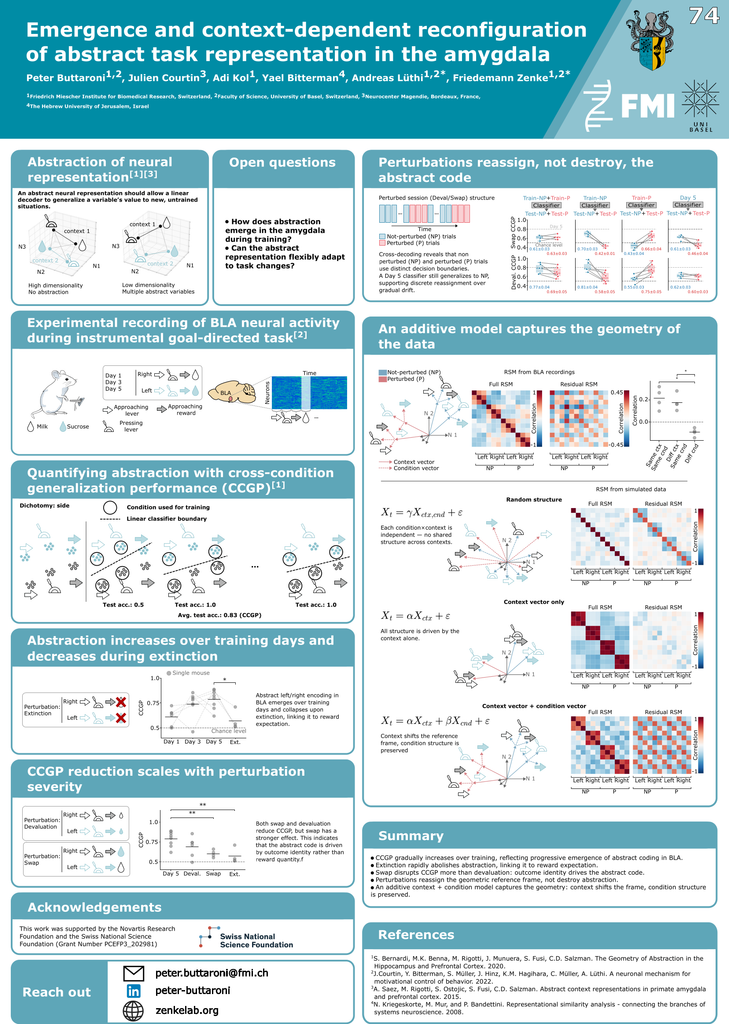
1-074: Emergence and context-dependent reconfiguration of abstract task representation in the amygdala
Tuesday 29th, 16:30-18:00 (Peter)
How does the brain build task representations that are both specific and flexible? Using longitudinal calcium imaging in mouse basolateral amygdala, we show that an abstract code for task variables emerges gradually over training and collapses within a single extinction session. When reward contingencies change, abstraction is not lost: the representational geometry reorganizes by reassigning a reward-identity reference frame while preserving a behavioral-phase component, revealing a compositional code that is selectively reconfigured.
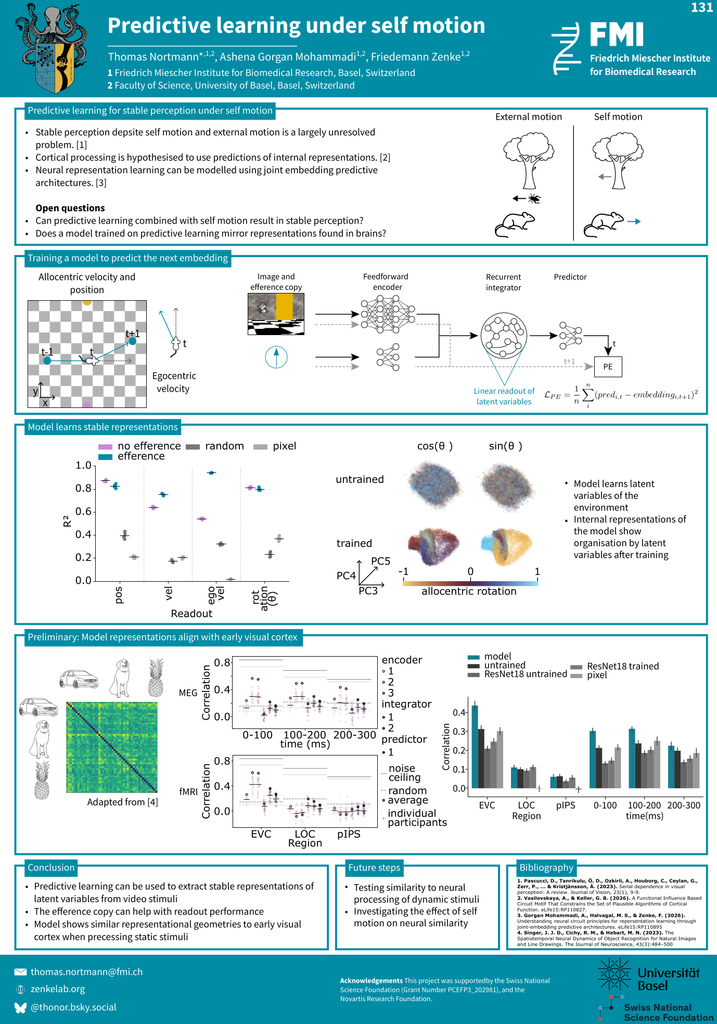
3-015: Predictive learning under self motion: A normative model for representation learning in the visual cortex
Wednesday 30th, 12:30-14:00 (Thomas)
How can the brain learn representations about the environment during self motion? We propose that predictive learning can be used to extract latent variables of the environment. The learned representations show similarities to in-vivo data.
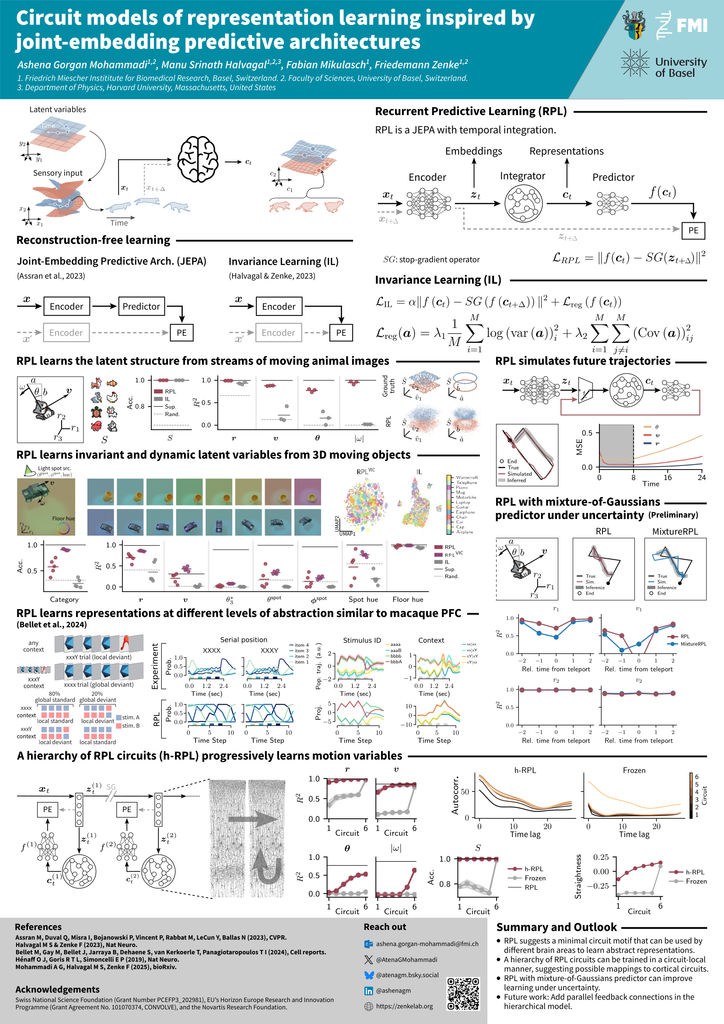
4-005: Circuit models of representation learning inspired by joint-embedding predictive architectures
Wednesday September 30th, 14:00-15:30 (Atena)
Inferring object identity and predicting their motion is essential for survival. We introduce Recurrent Predictive Learning (RPL), suggesting a general circuit motif that can be used by different brain regions to learn representations at different levels of abstraction.
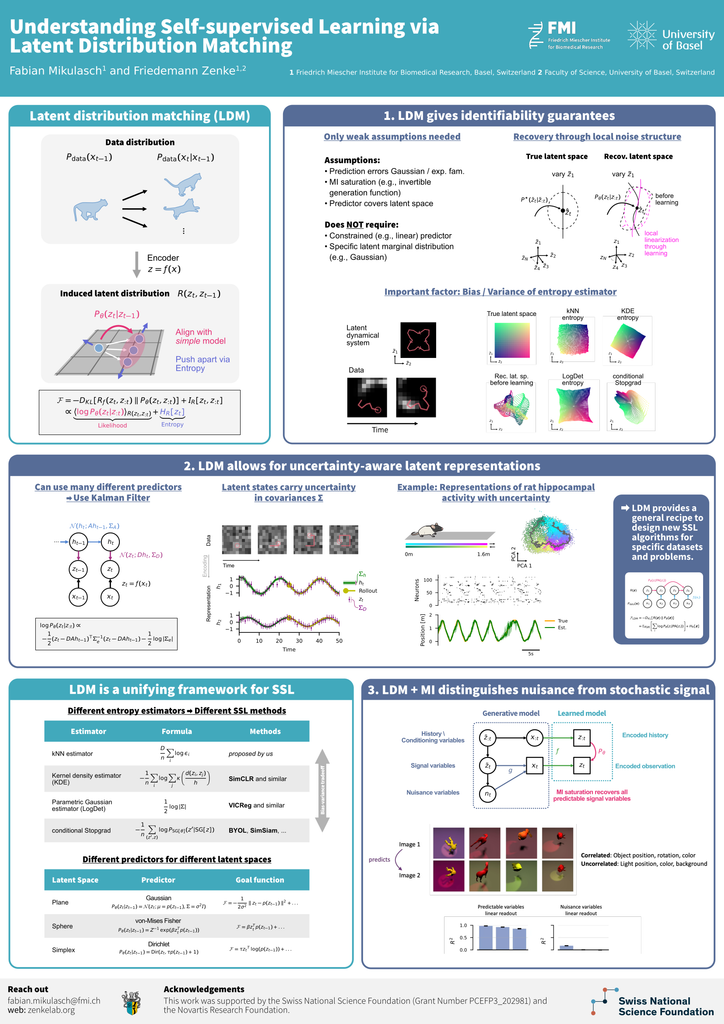
4-063: Latent Distribution Matching as a General Framework for Self-supervised Learning
Wednesday September 30th, 14:00-15:30 (Fabian)
Latent distribution matching (LDM) provides a unifying framework for self-supervised learning by interpreting diverse methods such as SimCLR, VICReg, and stop-gradient approaches as matching encoder-induced latent distributions to specified latent models. This perspective enables principled design of new SSL algorithms, including uncertainty-aware models, and yields broad identifiability guarantees for recovering latent variables in nonlinear dynamical systems.